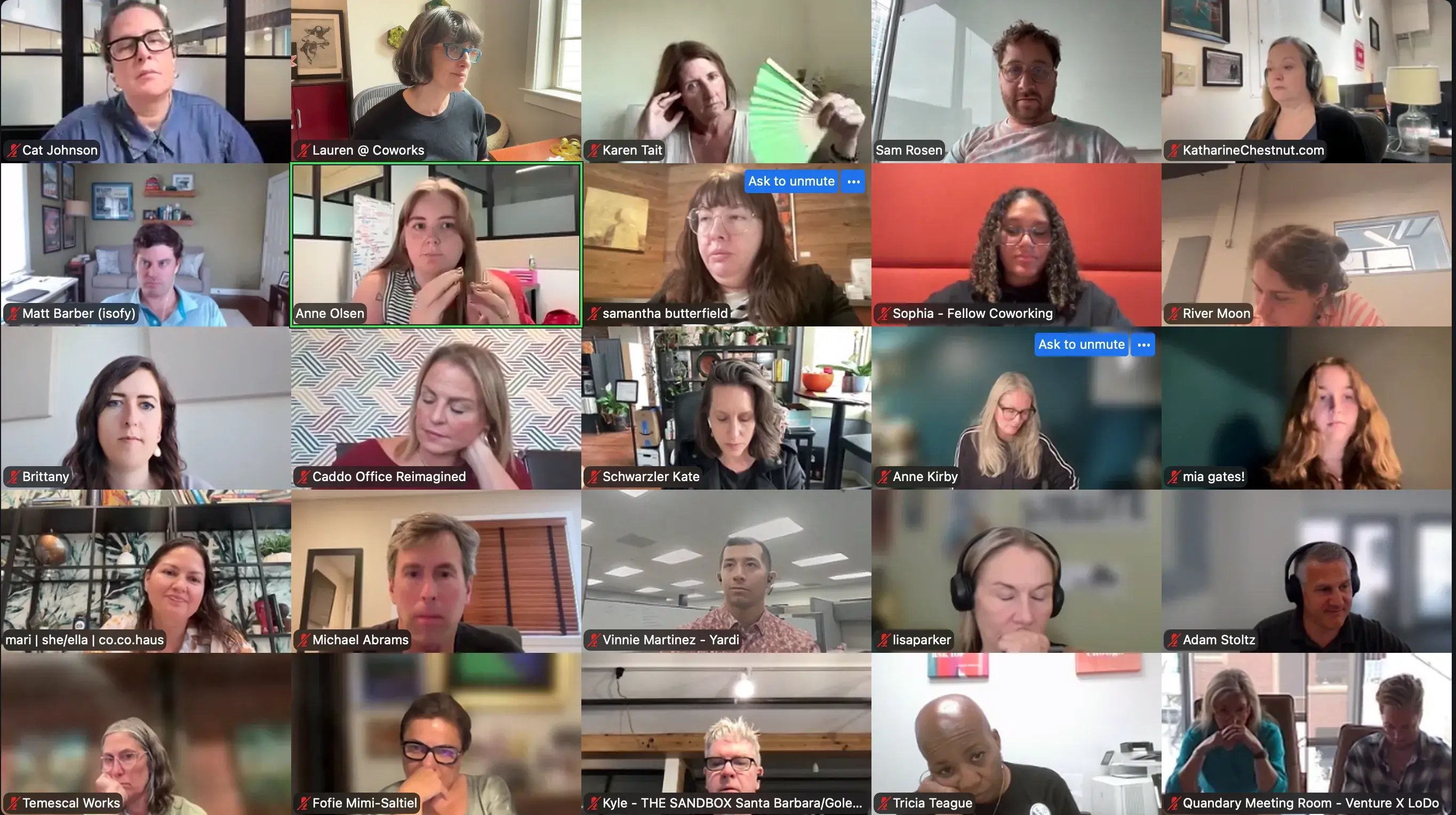
More than 60 coworking operators from around the world logged into Coworking Convos, the monthly industry gathering hosted by Cat Johnson.
The topic: creative marketing strategies for your space.
Four industry veterans shared what's actually working in their spaces: Anne Olsen from The Shop Workspace (Salt Lake City + Brooklyn), Mariangie Rosas from co.co.haus (San Juan, Puerto Rico), Sam Rosen from Deskpass, Yardi, and Two Thirty (Chicago), and Karen Tait from The Residence (Hertfordshire, UK).
Market the place, not the space
 Anne Olsen opened with a story that perfectly captured her entire philosophy.
Her Brooklyn location, The Shop Workspace, has been open less than a year. In less than 10 days, the team co-organized a block party celebrating the reopening of the Carroll Street Bridge, a beloved neighborhood landmark closed since 2021.
More than 1,000 people showed up. There was a bubble machine, a costume contest, an eight-foot puppet, and kayakers gliding under the bridge with inflatable art installations. By the following week, they'd booked four confirmed tours from people who found out about The Shop because of the event, and signed a two-person office on the spot.
There was not a single slide about hot desks.
"The most creative marketing has nothing to do with your space and everything to do with your place."
Her three frameworks for doing this:
Market what people will fall in love with. It won't be your conference room. It'll be the neighborhood, the easy parking, the coffee shop around the corner. Make those things central to your story. Build neighborhood guides. Know your local favorites. Be a connector to the place you're in.
Buy local on purpose. Every purchasing decision is a chance to deepen your connection to the neighborhood. The Shop serves custom-roasted espresso sourced within 1.9 miles of each location, same price as buying beans from a big-box store, but far more meaningful. Whether it's coffee, cleaning supplies, or snacks for your next event, ask yourself: who could I be buying this from instead?
Ask yourself: how are we more like X than Y? More like a Michelin-star restaurant than a generic office operator? More like a five-star hotel than a serviced office? This exercise gets interesting fast, and what you uncover is yours alone. No competitor can replicate your neighborhood, your history, your team.
Your CRM can be for connections, not leads
 Mariangie Rosas runs co.co.haus in San Juan, Puerto Rico, and when Cat first invited her to this panel, her response was essentially: I'm the wrong person. We don't really do marketing.
Then she thought about it.
"There has to be something we do great at marketing, because we basically sell everything through word of mouth."
Nine years in, with members who've been there since day one, co.co.haus is proof that the fundamentals are underrated. Mari shared three:
Deliver an experience worth talking about. That starts with actually knowing your members, where they are in their business, what they need, who in your community can help them. Co.co.haus uses their CRM not to track leads, but to track connections. When a member grows, the community grows with them.
Build a brand that's instantly recognizable, without a logo. Their name plays on 'community,' 'coworking,' and the Spanish word for coconut. Members are Coconuts. The team is Team Coco. The annual report is the State of the House. Every email has a palm tree or coconut emoji in the signature. No logo needed. You see a tropical emoji in a professional email, and you know exactly who sent it.
Turn your members into your marketing. Not with a formal referral program (they don't have one). With a platform. Their newsletter features a Coconut of the Month, nominated by other members. Their WhatsApp community keeps everyone in the loop, because in Puerto Rico, Slack never caught on. "You have to be where your members are," Mari said.
The lesson: marketing your community to the outside world is much easier once you've done the work of marketing to the community itself first.
Have a point of view
 Sam Rosen has been in coworking for nearly 20 years. He opened what may have been the first space in Chicago to call itself a coworking space.
He built Deskpass, which was acquired by Yardi. He runs Two Thirty in River North. He has more context than almost anyone.
His biggest takeaway from all of it: have a point of view.
"There's so much generic content out there, especially with AI. Have a point of view. Turn some people off, you'll turn some people on. Don't be everything to everybody."
His space calls their coworking area the Work Club. They're not marketing 'coworking.' They're marketing the view, the vibe, the community that is uniquely Chicago, uniquely River North, uniquely Two Thirty.
He also shared two tools worth your attention right now:
AI-assisted SEO. Sam uses Ahrefs connected to his website backend through an AI assistant. Each week, it pulls local search data, identifies gaps, and automatically updates his site. His local search ranking went from zero to outranking WeWork and Industrious in River North. It costs around $150/month and requires almost no ongoing effort.
A chatbot for your website. He installed a small widget called Tix.com, loaded it with info from his site and knowledge base, and it handled four overnight conversations on its very first day, including a hot desk inquiry, a meeting room request, and a 100-person event inquiry. It sold a membership before he woke up.
Stop trying to sell memberships in your ads. Just get someone through the door once. "If I just want to get somebody in the door to see the space, meet our community manager, we kill it. 80% of the time, people sign up."
Automations + cake
 Karen Tait runs The Residence in Hertfordshire, UK, precisely equidistant between London and Cambridge, as she will cheerfully inform you. She's been operating for nine years, built the space from 1,000 to 8,000 square feet, and spent very few British pounds on traditional advertising.
Her philosophy: retention is marketing.
"I think there are two strands to marketing. Acquisition and retention. We often focus on acquisition."
Karen invests as much energy in keeping members as finding new ones, because a member who stays 90 days tends to stay for life. They've formed habits, friendships, and a sense of belonging that's hard to walk away from.
Some of what makes The Residence sticky:
Free coffee and cake. Not a perk, a ritual. Members message Karen asking her to save them a slice when they're not in until Thursday. People mention the cake on Zoom calls. It costs money. It costs far less than the churn it prevents.
A jigsaw puzzle. Someone put it perfectly on LinkedIn: "I didn't join for the jigsaw, but I stayed for the jigsaw." It's a soft access point, something to do with your hands while a stranger sits down next to you and a conversation starts.
A walk club. Monthly, weather permitting, to a local vineyard.
Lunch and learns. Free for members, five pounds for non-members. Topics have ranged from LinkedIn strategy to personal styling to photography. Non-members come in, see the space, meet the community, and members do the selling just by being themselves.
Summer bundles. Last year, Karen offered 10 day passes for £280 (normally £350), usable over three months. She sold £5,000 worth in a short window. First time in 10 years of operating. The bundles boosted cash flow and multiplied touchpoints, more days in the space means more conversations, more reasons to join.
Responsiveness. She also moved from day passes to hourly access, 18 hours per month, for members who didn't need full days. That one change removed the barrier for a whole category of working parents and part-time remote workers.
What this means for your space
Every speaker kept coming back to some version of the same idea: marketing isn't about getting attention. It's about earning trust, through the place you're part of, the community you build, the small things that make your space feel like it belongs to the people in it.
You don't need a big budget. Anne threw a block party less than a year into her Brooklyn location. Karen started offering cake and called it a strategy. Mari built a recognizable brand without a recognizable logo. Sam automated his SEO and fell asleep while a chatbot closed a membership.
The tactics are accessible. The mindset is the work.
 Coworking Convos is a monthly virtual event series hosted by Cat Johnson. Each month, a different topic is presented by guests with real experience, who are subject matter experts and walk the walk in the coworking and flex space industry.
Coworks is a partner of Coworking Convos and the Coworking Creators Lab, and we have the privilege of sharing these dispatches afterward — spotlighting the juicy tidbits and powerful takeaways shared in the hour-long conversation.
But by no means does this replace the real value of being there! Check out the next Convo and be in the room when it happens.